
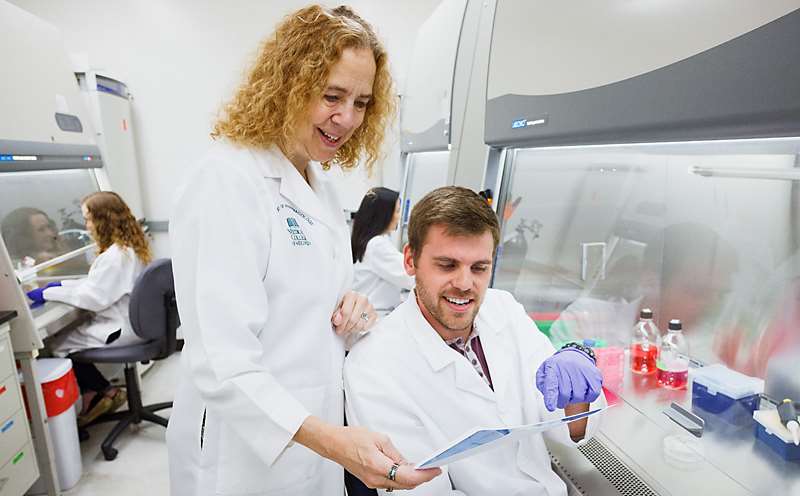
 For nearly 40 years, Carol Williams, PhD, has spent her career asking questions that many people never thought to ask. Not because they were fashionable or promised immediate answers. And certainly not because they guaranteed funding. She asked them because she wanted to know how life works.
That curiosity carried Dr. Williams from a childhood spent exploring the natural world in Illinois, where she chased snakes, collected insects, and developed a lifelong fascination with biology, to a career as one of the world’s leading experts on a protein few people had heard of and even fewer understood.
Along the way, she became the Joan K. Van Deuren Professor in Breast Cancer Research, Co-leader of the Cancer Center’s Cancer Biology (CB) Research Program, and an internationally recognized scientist whose discoveries helped reshape how researchers understand some of cancer’s most important signaling pathways. Her impact extended well beyond the lab through mentorship, education, and leadership in community-engaged initiatives such as the Research and Community Scholars program.
The résumé is impressive. The person is even more interesting.
Spend a few minutes with Dr. Williams and you meet someone who once considered becoming an actor, spent years scuba diving, rode with a Harley-Davidson club, and still talks about biology with the same enthusiasm she had as a teenager. The hobbies may seem unrelated, but they all stem from an endless fascination with how the world works.
“I love science,” said Dr. Williams. “I love everything about science. I want to know how things work.”
That simple idea became the organizing principle of an extraordinary career, one defined not by chasing headlines, but by following evidence wherever it led.
When the Data Whisper
Looking back, it’s tempting to connect the dots neatly from zoology to parasitology to cancer biology, but Dr. Williams never experienced her career that way. She simply followed the next interesting question.As a teenager, she found herself torn between science and the stage. When she arrived at the University of Iowa at just 16 years old, both seemed equally possible. She immersed herself in drama courses and loved performing, but she was just as captivated by zoology, botany, and biology. A course on parasitic diseases ultimately tipped the scales. “I fell in love with it,” she recalled.
That fascination led her to graduate school at the University of Minnesota, where she earned a PhD in parasitology, then to postdoctoral training in immunoparasitology and later cancer immunology at Mayo Clinic. Along the way, she learned an important lesson: scientists were not mythical geniuses. They were simply curious people trying to understand the world. So she decided to join them.
Early in her independent career, those questions led to one of her first major discoveries. Dr. Williams helped uncover a signaling pathway that regulates E-cadherin, a protein that helps cells stick together and plays an important role in cancer spread. The work was featured on the cover of the Journal of Cell Biology, an early indication that her willingness to explore overlooked questions could yield important answers.
Over time, those questions drew her into the signaling networks that govern how cells grow, move, and communicate. Her laboratory became particularly interested in Ras and Rho GTPases, molecular switches that help regulate essential cellular functions and, when disrupted, can contribute to cancer and other diseases.
One discovery, in particular, would shape the next quarter century of her career.
While investigating how these proteins are regulated, Dr. Williams and her colleagues identified a little-known protein called SmgGDS. Most researchers paid little attention to it, but Dr. Williams became fascinated. She often describes SmgGDS as a taxi cab. Its job is to pick up important molecular passengers and help them get where they need to go.
What began as an obscure observation grew into a series of discoveries that transformed understanding of how some of cancer’s most important signaling proteins function. Dr. Williams and her team showed that SmgGDS helps direct proteins such as Ras, Rho, and Rac to the right locations within cells and regulates a process known as prenylation, which allows them to carry out their work.
Those findings revealed a previously unrecognized level of control over pathways that drive cancer growth and spread, opening new possibilities for therapeutic intervention. Along the way, her team challenged long-held assumptions by showing that some of these proteins could even enter the nucleus, expanding understanding of where and how they function.
None of those discoveries happened because she was trying to prove herself right. In fact, some emerged because the data refused to cooperate. “The data are constantly whispering to us,” she said.
Too often, researchers become attached to a hypothesis and stop listening when results point somewhere unexpected. Dr. Williams always took the opposite approach. If the data contradicted her expectations, she saw opportunity rather than disappointment.
“If our hypothesis isn't correct,” she said, “that’s even more exciting.”
The work eventually earned international recognition, culminating in a 2024 keynote plenary lecture at the FASEB Conference on Protein Lipidation, where Dr. Williams was invited to reflect on discoveries that had helped reshape understanding of how these critical proteins are regulated inside cells.
Chasing the Truth
As retirement approaches, Dr. Williams is surprisingly reluctant to define her legacy through a single paper, grant, or discovery. She is proud of the science, the students, and the knowledge her work helped uncover. But what matters most to her is something harder to measure.“I hope my legacy is that I wanted to find the truth,” she said.
This philosophy shaped both her research and her mentorship. An award-winning educator, Dr. Williams taught generations of scientists to follow the data, question assumptions, and listen carefully when results pointed somewhere unexpected.
One of Dr. Williams’ favorite analogies compares scientific knowledge to a giant jigsaw puzzle. Some discoveries become the sailboat, the lighthouse, or the face everyone notices when the puzzle is complete. Others are simply pieces of blue sky, findings that may seem small or unremarkable on their own. Yet without those pieces, the picture is incomplete. For nearly four decades, Dr. Williams has devoted her career to finding those pieces.
She found them in questions others overlooked, in unexpected results that challenged conventional thinking, and in the quiet whispers of data that suggested something more was waiting to be discovered.
The picture is far from complete. But thanks to her science, her mentorship, and her relentless curiosity, it is far clearer than it was before.
And thanks to Carol Williams, the rest of us can see a little more of the sky.
Learn more about Dr. Williams’ research.