
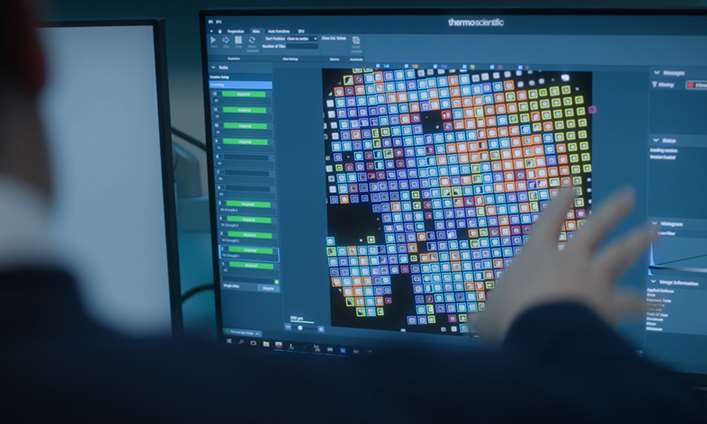
 At the MCW Cancer Center, data isn’t a byproduct of research—it’s the engine accelerating the entire scientific enterprise. It moves discoveries from labs into patient care, links molecular insights to clinical decisions, and allows teams across disciplines to solve problems together that no single lab or clinic could solve alone.
Here, precision oncology is not simply a program. It’s an ecosystem where structural biologists, computational modelers, statisticians, genomic scientists, clinicians, and data engineers all work in a connected cycle: discover, validate, predict, personalize.
Mapping the Origins of Cancer
His recent study on hepatocellular carcinoma (HCC), a highly aggressive liver cancer, is one example of how foundational science connects directly to clinical need. By analyzing large datasets, including the Cancer Genome Atlas, Dr. Liu’s team found that the protein GOLM1 is dramatically elevated in HCC and correlates with poor survival. Building on this evidence and leveraging the Structural Biology Shared Resource led by Dr. Liu, they discovered that the compound CC-885 can recruit a ubiquitin ligase complex to degrade GOLM1, shutting down the tumor’s ability to build blood vessels.
“By combining clinical data with mechanistic modeling, we were able to connect what we see in patients with how cancer behaves at the molecular level. This integration of data and biology is helping us find smarter ways to interrupt the processes that allow tumors to grow and spread,” said Dr. Liu.
While it’s an early discovery, Dr. Liu’s work shows that sometimes the smartest way to beat cancer is to help the body’s own molecular processes do what it already knows how to do—heal itself.
“Data will continue to guide how we discover, validate, and refine cancer treatments,” added Dr. Liu. “By integrating genomics, structure, and computation, we can predict vulnerabilities long before they appear in the clinic—and design therapies that target cancer with unprecedented precision.”
Informing Next-Generation Therapies
As early insights emerge from the bench, they enter a second phase of the cycle: deep statistical analysis and population-level validation. This is where investigators like Kwang Woo Ahn, PhD, play a critical role. As Chief Statistical Director for the Center for International Blood and Marrow Transplant (CIBMTR), and a core member of MCW’s Data Science Institute, he uses advanced statistical and machine-learning techniques to analyze patient outcomes in ways that refine—and sometimes redefine—how emerging therapies should be used.In the largest study ever conducted on CD19 CAR T-cell therapy for primary mediastinal B-cell lymphoma (PMBCL), Dr. Ahn and collaborators compiled data from 66 centers to examine real-world outcomes for 135 patients. The results built the strongest evidence base to date for how this rare cancer responds to CAR T-cell therapy.
Using Kaplan-Meier survival analysis and competing risk analysis, the study showed:
- 67.7% of patients achieved complete remission
- 80.8% two-year overall survival
- 58.6% progression-free survival
- Low rates of severe side effects
- Reduced risk of relapse but slightly increased complications, highlighting the need to fine-tune treatment timing and order for each individual patient.
Dr. Ahn also oversees the CIBMTR’s Pediatric Cancer Working Committee, where he’s using data to rethink how childhood cancers are studied and treated.
“Pediatric research requires distinct analytical considerations,” he explained. “Children’s bodies are still developing, which changes everything—from how they tolerate therapy to how their immune systems recover. For example, while most children receive a myeloablative conditioning regimen before stem cell transplantation, older adults receive less intensive regimens due to age. This makes analyzing both groups together challenging.”
Translating Data into Personalized Care
Once discoveries are validated and patterns identified, they reach the frontlines of care as precision-guided decisions. This is where clinician-scientists like Razelle Kurzrock, MD, FACP, lead the next phase of innovation.
A trailblazer in precision medicine, Dr. Kurzrock has devoted her career to making sense of the staggering amount of genomic and clinical data generated by modern care. Cancer’s complexity only adds to the problem.
“It turns out that no two tumors are alike—just like no two people are. Moreover, since the average tumor has alterations in five genes, and there are 700 possible cancer-causing genes, the number of possible molecular patterns is in the trillions,” said Dr. Kurzrock.
To tackle this complexity, she and collaborators developed OncoAID, a new open-access database that integrates hundreds of targeted drugs, combinations, and molecular targets, regulatory pathways, and performance data—all supported by machine learning.
“OncoAID is a rigorously integrated, continuously updated oncology knowledgebase that enables rapid, intuitive search, filtering, and exploration across curated datasets and linked external resources,” said Dr. Kurzrock. The platform’s approach is outlined in a collaborative paper.
In the Rare Cancer and Precision Medicine Clinic, her team layers tumor sequencing, germline testing, gene expression data, protein signaling, and other multi-omic markers to fully characterize each patient’s cancer. Every treatment decision is then matched to this profile, mirroring the precision seen in research.
Looking ahead, she envisions “universal sequencing” across the Clinical Cancer Center, and a future where every patient benefits from the same depth of molecular understanding currently available in precision-focused clinics. “At the end of the day, our mission is to improve patient lives. Everything we do, every collaboration, every trial, every discovery, is about helping patients live longer and better.”
Dr. Kurzrock is now spearheading the evolution of precision oncology at MCW with the launch of the Center for Precision Oncology and Rare Cancers, a multi-disciplinary hub where researchers, clinicians, and data scientists work hand in hand. At the center, the use of data isn’t encouraged but required.
“Collaboration with data experts is essential,” she said. “Cancer’s complexity used to be an unsolvable problem, but now we can begin to solve it if we approach it from every angle. Our goal is discovery in real time, meaning bringing experts together and harnessing complex knowledge systems so we can formulate an advanced treatment plan for each patient in a few days.”
Learn how the MCW Cancer Center is advancing precision oncology.