
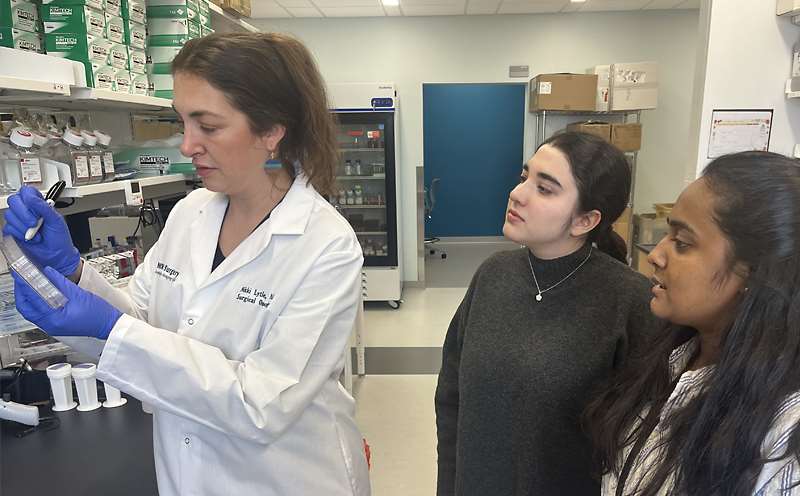
 For current and prospective students at the University of Wisconsin-Milwaukee (UWM), the opportunity to make an impact in cancer care doesn’t have to wait until after graduation. A growing partnership between UWM and the MCW Cancer Center is giving undergraduate students an early, hands-on entry for one year into the world of cancer research, and long before most students ever set foot in a lab.
The UWM Undergraduate Research Experience Program (UREP) launched in 2023 with a clear goal: bring the next generation of scientists into a one-year immersive lab experience early and help them build the foundation for a career in cancer research. Through a $10,000 scholarship, the program supports students as they work one-on-one with mentors they select, developing technical skills, writing funding proposals, attending conferences, and presenting their work at symposia.
“This program brings together curious, driven scholars whose work consistently demonstrates the strength of our next generation of cancer researchers,” said Jessica Olson, PhD, MPH, UREP Director and Associate Professor of Community Health.
To date, 28 students have completed UREP, and another 13 have just been matched with mentors, evidence of a rapidly growing training hub that is already reshaping the early-career research pipeline. Dr. Olson added she’s extremely proud of the students, many of whom are now applying to medical school, pharmacy school, and competitive lab positions.
“It’s very difficult for undergraduate students, especially those from diverse backgrounds, to find ways to participate in biomedical research,” said UREP mentor Nikki Lytle, PhD, Assistant Professor of Surgery.
“Increased diversity brings increased insight and increased progress,” Dr. Lytle said. “Programs like this are so critical for continuing to bring people into sciences that may not have had the opportunities.”
UREP mentor Paul Auer, PhD, Director of the Cancer Center Biostatistics Shared Resource, said the program also helps demystify the research process. Mentors guide students through every step, from developing the project idea to executing it, publishing the results, and presenting them. That journey can take years in a typical academic setting, Dr. Auer said and is rarely accessible to undergraduate students.“Having access to something like this would have certainly accelerated my development as a scientist,” Dr. Auer acknowledged.
“I think in my four years of being here, this was one of the most incredible opportunities that I could have had,” said UWM senior Parnian Vakili, a UREP alumna who has been working in the Lytle Lab since 2023.
Four years ago, Vakili moved to Milwaukee from Iran, where most of her family still lives, hoping to attend a research-focused university and eventually apply to medical school. Both of her parents are physicians—she grew up accompanying her mom, a gynecologist, to the hospital during night shifts—but it wasn’t until she arrived in Milwaukee that she discovered her passion for research.
The first time she saw her lab colleague, Priyanga Jayakrishnan, PhD, split cells, she was blown away. “It was incredible,” Vakili said.
That enthusiasm has stayed with her ever since. Vakili said she has enjoyed learning how to do experiments correctly and she feels deeply motivated that the results of her work could one day have clinical impact. Drs. Lytle and Jayakrishnan said they are both proud to see Vakili grow more confident in the lab; she now takes the lead on projects and doesn’t get discouraged when things don’t work the first time.
“I still get excited when I do the most basic things” in the lab, Vakili said.
Currently, she and Dr. Jayakrishnan are investigating the role of midkine in pancreatic cancer liver metastasis—a project she never imagined tackling when just a few years ago, she didn’t know how to hold a pipette.
“It’s so cool,” Vakili said about her time in the Lytle Lab. “It’s crazy that I get to do this and I couldn’t be more thankful.”
Connecting Data, Discovery, and Personal Purpose
For most of high school, Kali Quade, a UWM senior, planned to pursue a career in engineering. Instead, Quade discovered she loved learning about the body’s different systems. She applied to UREP, where a program director encouraged her to connect with Dr. Auer.
It turned out to be a perfect match. Now, in the Auer Lab, Quade is contributing to a genome-wide association study (GWAS), analyzing a 500,000-person, NIH-funded genetic database to characterize the prevalence of blood cancer. The project blends her interests in biochemistry, math, and a desire to better understand a disease that has affected her own family.
“I’ve had family members who have had cancer, and it’s really had an impact on me seeing how their disease progressed and what they went through,” Quade said. “I really felt like I wanted to make an impact as much as I could as an undergrad, and I think this program has helped me do that.”
Dr. Auer said he’s been impressed with Quade’s patience and persistence in the lab, especially as she taught herself to code on several different platforms. She has also been developing science communication skills and learning how to talk about the significance of her work to the people who might benefit from it.
“During presentations, I’ve had people come to me and tell me that their loved one also has cancer, mostly the specific type [of hematologic malignancy] that I was presenting on,” she said. “I think that’s really touching and it kind of makes the experience the most worthwhile.”
Charting a Path Toward Careers in Cancer Research
Vakili and Quade plan to apply to medical school next year, and both imagine careers that integrate research with patient care.
Vakili never expected to enjoy oncology—she always thought of it as too emotionally difficult—but now says it’s the field she’s most drawn to. She hopes one day her work will contribute to new treatment protocols or help someone feel less afraid of a diagnosis.
Quade feels lucky that she’s met so many inspiring people during her time with UREP, including keynote speakers, potential collaborators, and many physician-scientists who model the kind of career she aspires to build.
Both mentors agreed they would have benefited from a program like UREP when they were navigating college. “I would have gotten where I was headed a lot earlier in my career if I had had opportunities like this certainly as an undergrad,” said Dr. Auer. “If we’re going to continue on as a field, we’ve got to get the young people involved at an early stage.”
Learn how the Cancer Center supports trainees at all levels.