
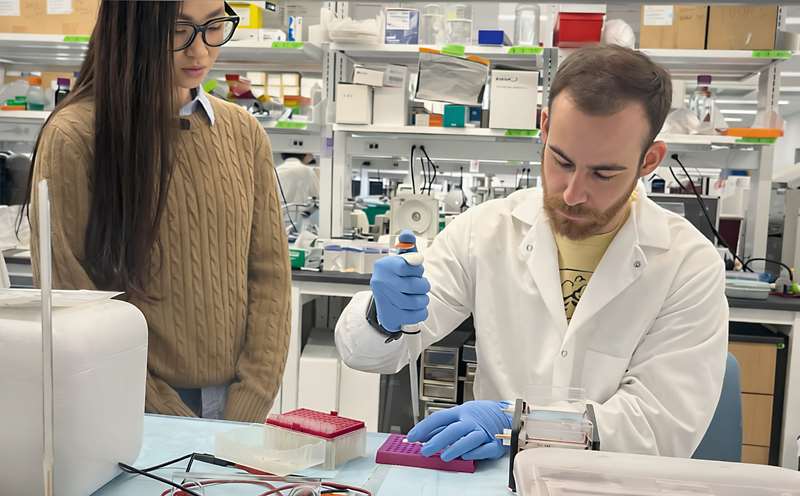
 In a lab filled with humming instruments and glowing monitors, Lan Zhu, PhD, spends her days chasing something invisible. The molecules she studies are far too small to see with the naked eye, yet they help control how cancer cells grow, communicate, and resist treatment. She is relentless in her pursuit of revealing these shapes, knowing that once scientists can see how these molecules are built, they can design drugs to stop cancer at its source.
For Dr. Zhu, assistant professor of Pharmacology and Toxicology and member of the Cancer Biology Research Program, the mission is both technical and deeply practical: understand cancer’s molecular machinery well enough to outmaneuver it.
“My overall goal, through structure-based drug discovery, is to design rational drugs that target G protein–coupled receptors and give patients a third or fourth treatment option for better outcomes and improved survival,” said Zhu.
That vision is rooted in one of biology’s largest (and most mysterious) protein families: G protein-coupled receptors, or GPCRs. These receptors sit on the surface of cells, acting as molecular antennas that detect signals from the outside world and translate them into activity inside the cell. More than 800 different GPCRs exist in the human genome, and nearly one-third of all FDA-approved drugs target them. Yet scientists still understand only a fraction of them.
Dr. Zhu is determined to change that.
Making the Invisible Visible
At the heart of Dr. Zhu’s research is a deceptively simple question: What do the molecular switches that control cancer actually look like?
GPCRs help cells sense signals from their environment—hormones, neurotransmitters, and other molecules—and convert those signals into instructions inside the cell. Many cancers hijack these pathways to survive and grow. Yet despite their importance, hundreds of GPCRs remain structurally unexplored.
“If you don’t understand these structures, how could you design drugs to target them?” Dr. Zhu asked.
Her lab focuses on one particularly intriguing receptor: GPER, the G protein-coupled estrogen receptor. Unlike the better-known estrogen receptors that operate in the cell nucleus, GPER sits at the cell membrane and can trigger rapid signaling events. Dr. Zhu believes it may play an underappreciated role in breast cancer, particularly in cases where tumors develop resistance to existing therapies.
When drugs block traditional hormone pathways, cancer cells often adapt by activating alternative signals. GPER may be one of those escape routes, she explained.
To investigate this, Dr. Zhu relies on cryo-electron microscopy (cryo-EM), an advanced imaging technology that allows scientists to visualize proteins in remarkable detail. Within the Cancer Center’s Structural Biology Shared Resource, this cutting-edge instrumentation freezes biological molecules and reconstructs their three-dimensional shapes at near-atomic resolution.
“Cryo-EM helps us visualize not only the structure of GPER, but also the complex structures of GPER interacting with other proteins involved in breast cancer,” Dr. Zhu explained.
These structural snapshots allow Dr. Zhu and her team to understand how receptors activate, how they communicate with other signaling partners, and how those interactions might be disrupted by carefully designed drugs. Each new structure brings scientists one step closer to designing therapies that can overcome drug resistance and give patients additional treatment options.
Training Scientists to Think Like Clinicians
For Dr. Zhu, the ultimate impact of her work goes beyond solving molecular structures. It lies in building the knowledge, technologies, and people who will drive the next generation of cancer discoveries.
Her lab trains graduate students and early-career physician-scientists who are learning to think across disciplines, combining structural biology, cancer biology, and drug discovery. Among them is Brandon Patterson, a third-year PhD candidate studying structural biology. What stands out most to Patterson is her approach to mentorship.
“She’s a hands-on PI. Her office is always open and we have very open-ended communication. She’s not afraid to come into the lab and show me how to do certain experiments when I need help,” said Patterson.
For Patterson, structural biology feels a bit like solving a puzzle. If researchers can understand what a receptor looks like and how it behaves, designing drugs to target it becomes far more precise. That kind of thinking is exactly what Dr. Zhu hopes to instill in the scientists she trains: researchers who understand both the biology of disease and the realities of patient care.
“You cannot only sit in a lab or only treat patients,” Dr. Zhu explained. “You need to understand the molecular mechanisms of disease and how they contribute to the therapeutic strategies doctors use.”
That philosophy reflects what drew her to the Cancer Center. Regular conversations with clinicians, pathologists, and translational scientists help her team connect molecular discoveries with real challenges in patient care. Shared technologies and cross-disciplinary expertise make it possible to pursue questions that no single lab could answer alone.
“The collaborative environment is critical for me to work here,” she said.
Learn more about the Zhu Lab and explore opportunities for collaboration.