
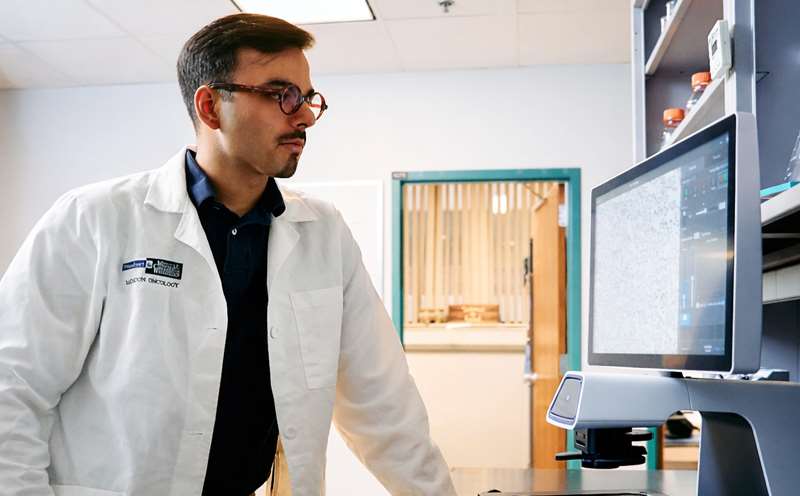
 For Abdullah Memon, a third-year medical student at MCW, the next year will look different from most of his peers’. Instead of balancing lectures and clinical rotations, Memon will spend a full year immersed in cancer research as the inaugural recipient of the American Cancer Society (ACS) Medical Student Fellowship. The award provides protected research time and dedicated mentorship through the MCW Cancer Center, an investment in developing the next generation of physician-scientists.
Medical training leaves little time for students to pursue meaningful research, even for those interested in scientific discovery.
The fellowship offers students a unique opportunity to gain immersive research experience and build a foundation for a career in cancer science. During the program, fellows work alongside faculty investigators on projects spanning basic science, clinical research, and population science, contributing to studies while learning how discoveries move from the lab toward patient care. By supporting trainees at this critical stage, the Cancer Center is strengthening the pipeline of physician-scientists who will drive future cancer care.
From Curiosity to Cancer Research
Long before medical school, Memon was drawn to big scientific questions. As an undergraduate at Penn State University, he worked in a plant biology laboratory where he learned experimental techniques and explored how science could address global challenges.
“I worked in a basic science laboratory, where we were asking and answering existential questions like how we would feed the population in the event of catastrophic scenarios like nuclear warfare or supervolcano eruptions,” he said.
Those early experiences sparked his curiosity but also clarified what he wanted next. “My undergraduate research experience gave me an early outlet to explore curiosity through science,” he said. “While that work was intellectually stimulating, it lacked the human element.”
That realization set him on a path toward medicine.
When Memon arrived at MCW, he joined the Cancer Center’s Clinical Trials Office (CTO) as part of the Solid Tumor Oncology team, supporting clinical trials in head and neck, thoracic, sarcoma, and skin cancers. At first, clinical trials were unfamiliar territory. But the role quickly gave him a firsthand look at how new therapies move from research to patient care.
Cynthia Dwight, RN, ND, CCRC, CTO Assistant Director of Clinical Operations, said that roles like research assistant or coordinator often give early-career professionals a rare start-to-finish view of the clinical trial process.
“Like most new graduates, Abdullah began with little understanding of clinical trials,” she said. “But over time, his initiative, along with his ability to identify areas for improvement and implement effective solutions, made him a major asset to the team.”
For Memon, the experience offered a clear view of patient-centered research. It also raised new questions about the biology behind the diseases being studied—questions that ultimately drew him toward the laboratory.
The Lab That Shaped a Scientist
Memon transitioned into the laboratory of Joseph Zenga, MD, a head and neck cancer surgeon-scientist focusing on tumor immunology. What began as a chance to gain technical experience soon became a defining moment.
“I did not enter medical school knowing I wanted research to be such a central part of my career,” said Memon. “That changed the more I worked with Dr. Zenga and the team here at MCW. His drive and determination are infectious, and he provided me with what felt like a home base within the chaos of medical school to learn and ask questions.”
Through this experience, Memon saw the impact of Dr. Zenga’s mentorship—a careful balance of support and independence. What began as a summer research fellowship grew into full-time research away from the clinical curriculum, allowing him to pursue formal training in research methodology.
“What makes this effective is that students are not just ‘helping’ on a project,” said Dr. Zenga. “They are learning how to ask questions, interpret data, and take responsibility for decisions. At the same time, they receive close guidance and frequent feedback.”
Through this approach, Memon learned that research depends less on perfection and more on persistence, critical thinking, and the ability to navigate uncertainty.
“Medical training often rewards certainty, whereas science is full of ambiguity. In our lab, we emphasize how to ask the right questions, how to recognize when data are inconclusive, and how to iterate thoughtfully,” said Zenga.
Training to Advance Immunotherapy
The skills and perspective Memon developed under Dr. Zenga soon translated into tangible research outcomes, including multiple published papers. Among them was a study profiling cancer-testis antigens (CTAs) across more than 600 head and neck tumors using advanced transcriptomic analyses. The team identified a set of tumor-restricted CTAs that represent promising precision immuno-oncologic targets in a malignancy where outcomes remain poor.
That work now forms the foundation of his fellowship research, which focuses on developing patient-specific immunotherapies by discovering and targeting T cell receptors (TCRs). The long-term strategy is to harness a patient’s own immune cells, engineer them to recognize CTAs, expand them in the laboratory, and return them to the patient.
For patients with limited treatment options, the urgency of this work is clear.
“Through the work and the questions it’s raised, I’ve learned that we need to take a page from cancer’s playbook and work just like it does, day and night, 365 days a year, to understand and develop new ways to confront it,” said Memon.
The fellowship also provides Memon the opportunity to apply his lab discoveries in a collaborative, multidisciplinary setting. His project will be co-mentored by Dr. Zenga and Heather Himburg, PhD, with support from Musaddiq Awan, MD, Fumou Sun, PhD, and Peiman Hematti, MD and Tyce Kearl, PhD from the Cancer Center’s Cell Therapy Shared Resource.
Dr. Zenga described the fellowship as a pivotal moment in Memon’s training. “It allows him to develop the habits and mindset of a physician-scientist early: formulating hypotheses, working through failure, and communicating scientific ideas clearly. I see it as an important step that will accelerate his trajectory toward an academic career that integrates patient care with impactful research.”
For Memon, mentorship proved to be one of the most transformative parts of his journey.
“Early on, mentorship felt like an abstract concept rather than something I actively sought out or fully understood,” said Memon. “I only truly realized the profound impact mentorship can have when, as a result of it, I figured out what I wanted my future career and life to look like.”