
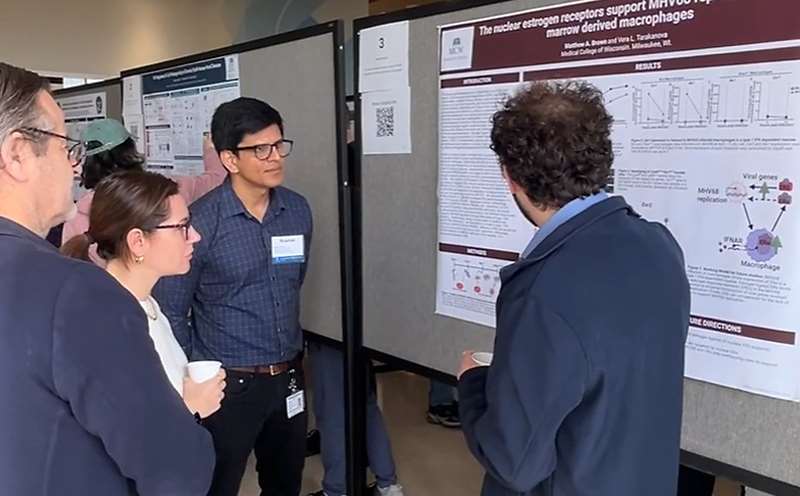
 For the first time this May, students, postdoctoral fellows, researchers, and clinicians came together at the Center for Cancer Discovery for the fourth annual MCW Cancer Center Trainee Symposium, creating a space for early-career scientists to present their research, exchange ideas across disciplines, and advance discoveries that could help shape the future of cancer care.
The symposium drew nearly 200 attendees this year, underscoring its growing role as a flagship showcase for the next generation of cancer discovery at MCW. According to event co-Chair William A. Hall, MD, Professor and Chair of the Department of Radiation Oncology, the ongoing investment MCW makes in its trainees helps ensure the future of cancer therapy will be better than it is today.
“Trainees are coming at these historic, long-standing challenges in cancer research and innovation with a totally fresh perspective. Those fresh perspectives are going to result in transformational changes to cancer care,” said Dr. Hall.
MCW leaders applauded attendees for asking the questions in their research that will help advance science and save lives, especially during a time when funding support at the federal level is uncertain, said Jose Franco, MD, Senior Associate Dean for Education, MCW School of Medicine.
“Your work directly translates to improving lives,” Dr. Franco told the audience, which brings the finish line—ending cancer—a little closer.
“Follow That Curiosity”
Trainees at all levels, from undergraduates to postdoctoral fellows, shared research findings through oral, poster, and one-minute speed presentations, covering a variety of topics, such as:
- Evaluating RTOG 0227 induction therapy approaches aimed at improving treatment response for patients with central nervous system lymphoma
- Studying how the protein ATP5E and cancer-associated fibroblasts may contribute to pancreatic cancer growth and progression
- Investigating G-protein receptor class 6A as a potential therapeutic target for prostate cancer treatment
- Identifying T cell signatures that may help predict which patients are most likely to respond to immunotherapy treatments
Attendees also heard from keynote speaker Brent Stockwell, PhD, Chair of the Department of Biological Sciences and Professor at Columbia University. Dr. Stockwell shared tips that helped him early in his career: hypothesize boldly, take time to think in a quiet place, and adopt new technology.
“You really want to follow that curiosity,” he said.
According to Dr. Hall, MCW is a place where trainees can do just that, thanks to dedicated mentors who have the time and bandwidth to support them.
For Rachel Cusatis, PhD, Associate Professor of Hematology and Oncology, supporting trainees is critical because they form the foundation of where the field is headed. She prefers working alongside them rather than above them.
“Whether you’re an undergrad student, a postdoc, or anywhere in between, we all bring a really valuable perspective to the research and so we all share equal opportunity to contribute to the research,” Dr. Cusatis said.
Taking Collaboration from the Lab to the Community
Trainees at the symposium said the collaborative environment at MCW makes it an ideal place to build a career in cancer research.
“There are various projects I’ve been on that have maybe two or three PIs where we all come together and really just lift each other up,” said Michael LeClaire, a graduate student in biochemistry. In the lab of his mentor, Brian Smith, PhD, LeClaire has had opportunities to do advanced biophysical and biochemical work that has made his experience at MCW unique.
“Everyone you work with is really just on your side and wants to help you get where you want to go,” added medical student Lauren Schraufnagel. She’s developed a close relationship with her mentor, Angela Steineck, MD, who has been supportive of her project as well as her life outside of MCW.
Other trainees, like doctoral student Mychoua Vang, MPH, said that being at MCW has allowed them to bring that collaboration outside of the hospital or lab and into the community.
Vang worked with Milwaukee nonprofit organization Health Forward to explore how faith-based groups can combat isolation and depression in elderly people. As a former community health worker, she wanted to address some of the social barriers she saw people face outside of the clinical walls before they’re able to access healthcare.
“Being able to focus on the community side of things and to showcase that this work matters too—that these community assets are vital to addressing cancer—that’s why I wanted to be here,” she said. For community members who might be eligible for studies like this, MCW has a responsibility to explain how the research is conducted so that it’s thoroughly understood, said Jamare McMurtry, an undergraduate at UW- Parkside and data specialist in the Sarah Kerns Lab.
During his work on a study involving prostate cancer survivors, McMurtry told the audience that one person refused to participate because his father was part of the Tuskegee study.
“People don’t want to be the first participant,” McMurtry said. “They just want something that’s established,” and MCW can close the knowledge gap to help build that trust.
The MCW Cancer Center thanks the Cancer Research Training and Education Coordination (CRTEC) team, administrative staff, and event planning committee that helped make this event a success.